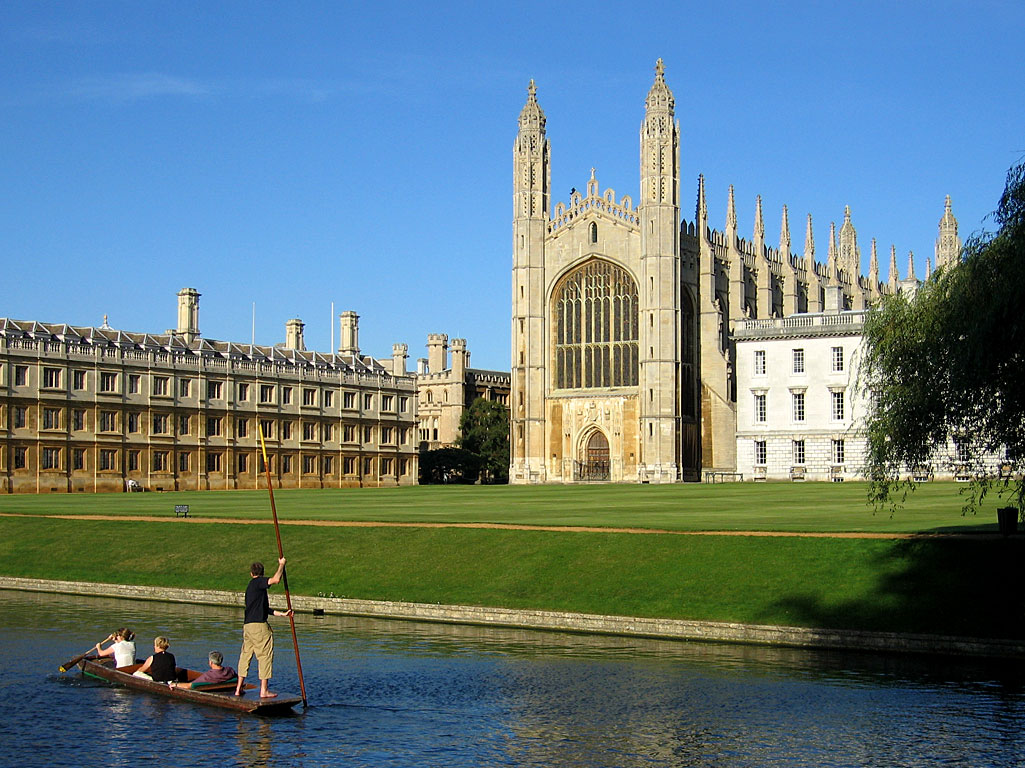
There are few things as exciting to me as being taken to a restaurant for the first time. I love the anticipation of a meal out, of not knowing anything about the restaurant itself (except for the dress code, of course), and then to have its mystery slowly unraveled, hint by hint, until finally it finally comes into view and I know that I have arrived. It was this romancing of the restaurant that I was so fortunate to experience when I was taken out to dinner by the Hopes one evening in Cambridge to a lovely restaurant called Midsummer House.
But before I continue, I must pause to express my gratitude to John, Ann and Naomi for giving me this incomparable gift of sharing a first-rate meal. The food and that atmosphere were, as you will see, most exceptional. But in keeping with my central tenet of culinary culture, rarely can a meal of any caliber be enjoyed so well by yourself as it can in the company of others. To share an extraordinary meal with an extraordinary family – that in itself is a unique and blessed gift for which I will always be grateful and happily revisit often in my memories.
I was truly glad that I had packed the new dress I purchased at the Saks Fifth Avenue First Cut Sale the week before, because when I asked Naomi if a formal dress would be appropriate for dinner, she said: “Well, I do believe so, yes.”
In the morning, I asked John the name of the restaurant. “Midsummer House,” he said nonchalantly. “We’re going back to Cambridge. That's the second time this trip! It must be a sign, Amanda. I think you’re due to come back here to England someday after all.”
That evening, I followed Naomi’s lead as she elegantly and daintily slipped into the little red Mercedes wagon car, and once inside and after having crossed the pebbled driveway in her house shoes, she unpacked her heels from a shoebag and popped them on her pedicured feet. Anne sat queen-like and elegantly in the front, while John was at the driver’s wheel, stately and calm though the level of excitement was perceptibly high.
“So, tell me a bit about this restaurant, please, John,” I asked as I got my mental pen and reporter’s notebook ready in my head. “The chef is Daniel Clifford.” That was the first clue. When someone mentions the chef of a restaurant first, this clearly means that the restaurant is of significant note. “The chef and his staff change the menu every month.” This second clue affirmed the first clue to the restaurant's excellence in showing that the chef’s monthly menu change would mean a sharp attention to detail in his food. “And I think it has two, yes that’s right, it has two Michelin stars.”
I was then
really happy that I had decided to bring my dress.
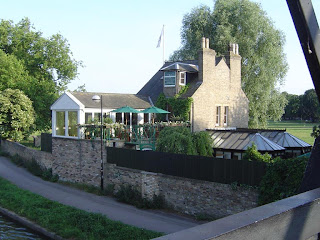
To get to Midsummer House, one must first navigate the very tiny and crowded residential back roads of Cambridge, and then start praying to the parking gods that there will be room enough on the street to park the car. After finding a spot and a leisurely walk on an enchanted-looking bridge over the River Cam, the restaurant came into view through the weeping limbs of an ancient Sycamore tree: it was a regal, Victorian stone cottage with a veranda and two chimneys. A garden was walled in with privacy screens atop, within which was a large greenhouse extension with wall-to-wall glass that come together in the front in two round bay windows. A little green, waist-high gate was the entrance onto the charming property, behind where a doorman opened the heavy wooden door with a smile and a polite salutation of “Bonjour, mesmdemoiselles.”
The décor of the restaurant is a very simple white, and uses artistic, wooden accents and glass sculptures to complement the stunning garden outdoors. The tables, dressed in white settings with a single, burgundy calla lily reclining in a clear glass vase, are spaced far enough apart to make this very intimate space seem like your own private dining room. As the four of us were seated, I felt like the very grateful guest of the Royal Family of the Priory, and my enchantment with my surroundings and my new friends took my breath away.
The menu of Midsummer House is available à la carte or as a tasting menu. The à la carte menu features a three-course prix fixe, with a cheese course and a coffee course available at an additional charge. We opted for the prix fixe, which gave us the chance to debate and explore our options as we sipped our aperitif.
The meal began with champagne and a toast to happiness and good health. A short while after, one attending waiter rolled a wooden cart to our table, which carried a beautiful pink and turquoise glass globe. Out of the globe’s top was a spray trigger, like those one finds on old-fashioned spritzer bottles. From this he sprayed a pale, white-pink cloud into purple glass cups shaped like the flower of the calla lily, as he explained: “Grapefruit foam with Champagne.”
The foam was sweet, tart and danced on my tongue. It was like tasting the cream of champagne foam, if such a thing existed to be able to scoop it with a tiny, silver spoon. It can only be described as one would describe a fine wine: it had notes of citrus and spring wildflowers, with a creamy finish and an aftertaste that sparkled. I ate this bit of cloud very slowly, hoping that it would not finish – or fall – too soon. After the cool refresher, we were treated to another delight: a warm pea velouté, smooth with a foamy cream. The velvety green soup was mostly broth, but in addition to the occasional green pea, there were bits of prawn suspended in the thick near the bottom of the four-sided pyramid-shaped bowl. This soup taster was not strongly flavoured so as to showcase the fresh purity of its ingredients. After the cool foam cleansed our palates, the warm smoothness of the pea velouté warmed our stomachs in preparation for our forthcoming meal.
Our whole table chose the same starter: a scallop dish of seared, hand-dived scallop, topped with truffle and Granny Smith apple matchstick accents. Off to the side was a smear of a celeriac purée, and around the plates components was drizzled a savory-sweet caramel sauce. I find scallops to be one of the most difficult things to cook perfectly; now thanks to the team at Midsummer House, I have a model to follow the next time I try to achieve seafood perfection. The scalloped were seared on the outside, while inside they were cooked just over the threshold of coming fresh from the sea. Their meat was almost like eating a ripe sea-fruit, kept moist and salty by the taste of seawater. The pure scallops were a stand-out by themselves, but their simplicity was perfect for enjoying the rich celeriac purée, the woody truffles, and the delicate caramel sauce.
The main courses were all different, and each was presented with an explanation and humble flourish by the charming French waitstaff. John ordered the Cannon of Lamb, which came with confit tomato, cous cous, broccoli purée and girolles. Ann ordered a beautiful dish of Anjou Squab Pigeon, poached and grilled rare, with sweet potato and spinach, cherries and pistachios, then finished with a theatrical drizzle of Valharona chocolate syrup and shaving of this fine chocolate on top. Naomi and I both ordered fish. Naomi enjoyed the Turbot, which came braised with a peanut and pistachio crust, atop a bit of spinach and spears of fresh green asparagus, decorated with pieces of squash and finished in a light vanilla sauce. I ordered the John Dory, a light yet meaty white fish that came with anchovy, confit tomatoes, slices of fennel bulb and black olive. The fish was so fresh, and the dish brought out the light, earthy flavours of Mediterranean cuisine. The confit tomatoes, though just an accent, were an absolute delight; they tasted as though they had been just picked from the vine, and were infused with the richness of fine olive oil.
The presentation of all of these dishes was a work of art. The meats and the fish were all arranged playfully between brushes of sauce and sprinklings of garnish. The arrangements allowed us to taste, re-taste and choose any combination of complementary flavours with each forkful. Clifford's attention to affinities between ingredients was most evident, as each combination was harmonious, exciting, delightful.
Following our mains, we took a moment of respite to sip our wine and let the savoury tastes of our meal linger before dessert. We were then presented with an unusual palate cleanser of pear foam within which was a marble-sized scoop of what appeared to be clotted cream. The surprise was the candied kalamata olives, which were as sweet as they were salty, and a very interesting accent to the sweet and fruity foam.
The arrival of dessert was yet another showcase of art. Ann ordered a cheese tasting, and was presented with an elaborate wooden cart from which she could choose a sampling of over a dozen artisinal farm cheeses from France and England. Our waiter was as enthused and educated about his cheeses as we were about tasting them. We ultimately chose five different varieties, from a very pungent and spicy bleu cheese to a soft and creamy goat's milk cheese. Naomi and I both ordered a fanciful Raspberry Dessert of white chocolate tubes, one of which was filled with raspberry jelly, the other filled with a white-chocolate ice cream. The dessert also came with a scoop of raspberry sorbet dressed in raspberry sauce, and was seasoned most interestingly with canidied tarragon. To my delight, the herb was an extraordinary compliment to the sweetness of the dish. Although I could appreciate the artistry of the dessert, I wished I had had more room in my stomach to have ordered the Apple Tart Tatin, spiced with vanilla, garlic, and bay leaf -- an intriguing and unusual combination. John's dessert, a Mango and Passion Fruit Delice, arrived on an enormous round, white plate, decorated in golden yellow drizzles of Christmas Tree Honey, with a touch of Lychee Sorbet.
With mint teas and an espresso all around, we finished our dinner with homemade chocolates and French
beignet patisseries. We dipped these fluffy, fried pastries in a caramel sauce and a pineapple sauce -- the caramel was so rich and creamy, and the pineapple sauce tasted of fresh pineapples without being too sweet.
We left out meal feeling satiated and delighted -- but not exceedingly full. Mr. Clifford's team at Midsummer House has done well in portioning their courses so that the diner may be able to taste everything without feeling gluttonous. The meal was a gift, and a joy to partake in. Every bite was like a celebration of ingredients and culinary experimentation that sought, above all, to suggest simplicity despite the layers of intricate artistry.
What made Midsummer House such a delightful experience, apart from the food, was the humbly elegant mood that the Victorian Cottage set for its diners. Even with the two Michelin Stars, the two Egon Ronay stars and 4 AA rosettes, Midsummer House still maintained a certain degree of humility and grace that make it stand alone from other fine restaurants. Daniel Clifford is passionate about food, and he is sincere about honing his craft. In my research about him, I gathered that Mr. Clifford is an unusually unpretentious chef, and his prerogative is to continually learn and make his restaurant better. Midsummer House is place where food is honored and delicately enjoyed. Mr. Clifford's cuisine, therefore, becomes a gift; it is served with joy and savoured with joy.
 Before I left for England, I got in the habit of telling people who asked about my journey that I was going specifically to London. This seemed to be a benign and logical explanation to me; I was on the last leg of my tri-city trifecta of travel to the three great Western cities of New York, Paris and London. I live in New York, I've left a piece of me in my appart in Paris, and now London was new territory in which I hope to someday live and make my mark. In my mind, this journey in June was in part a trial visit. But mostly, I was embracing the chance to see Naomi, to spend time with my dear friend who had only just moved back her family's home in England the week before.
 But Most importantly: go to England to eat. Eat up the stereotypes of pub food, taste the cuisine of Britain's former colonies, sip a coffee at a Starbucks in Notting Hill, have high tea the The Wolseley, ignore the exchange rate in order to understand why a Michelin star is indeed such a regal award. Get married at The Priory, find your London neighborhood, explore a village in the provinces, watch The Vanguard, go punting in Cambridge... go to England with an open eye and an empty stomach.